
When the Ground Can't Hold: A 100-Foot Deep Foundation Solution for Challenging Hillside Terrain
LPL Consultants Services
Some construction sites are simply difficult. Others present a combination of compounding challenges that immediately rule out every conventional approach. This hillside project fell firmly into the second category — a steep hillside site with variable near-surface soils, significant settlement concerns, elevated lateral loading demands, groundwater complications, and limited equipment access.
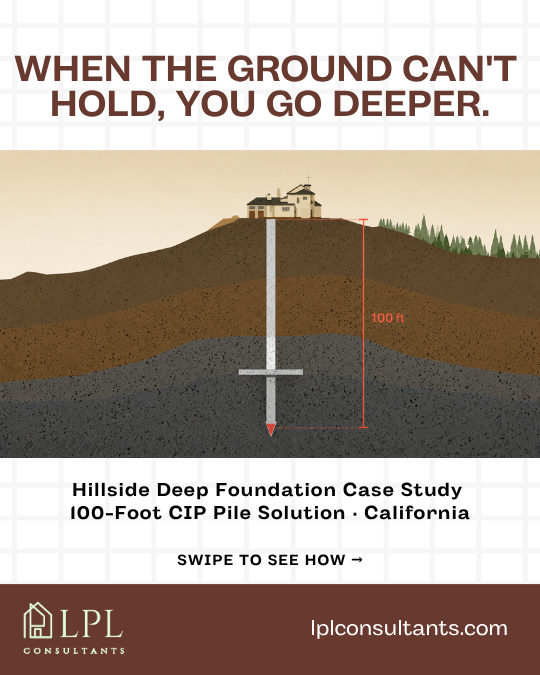
Shallow foundations were never a realistic option here. The site demanded an engineering solution capable of bypassing the unreliable near-surface strata entirely and transferring structural loads deep into competent bearing material.
LPL Consultants was engaged to provide structural engineering support and construction coordination throughout the project. After a thorough evaluation of available foundation systems, the team selected drilled Cast-in-Place (CIP) piles extending approximately 100 feet below grade — roughly the equivalent of reaching 10 stories underground.
This is the story of that project: the challenge it presented, the solution selected, and what it took to execute a deep foundation system of this scale in a constrained hillside environment.
The Challenge: Building on Hillside Terrain with Variable Soils
Why Conventional Foundations Weren't an Option
The project site combined several conditions that, individually, would each complicate foundation design. Together, they eliminated conventional shallow foundation options entirely:
- Variable near-surface soils — The subsurface conditions across the site were inconsistent, meaning shallow foundations would rest on unreliable bearing material. Any variation in bearing capacity creates differential settlement risk that compounds over time.
- Elevated lateral loads — Hillside terrain introduces horizontal forces that flat-site projects don't encounter at the same magnitude. Any foundation needed to resist both vertical gravity loads and lateral forces from the sloping site.
- Long-term settlement concerns — On sites with compressible or variable soils, structures on shallow foundations can experience ongoing settlement that damages the building and its systems. Eliminating that risk required reaching deep, stable bearing material.
- Groundwater complications — Subsurface water conditions introduced additional challenges during drilling, requiring active management to maintain borehole integrity throughout installation.
- Limited construction access — The hillside environment constrained which equipment could reach the site, which in turn influenced which foundation systems were even physically feasible to install.
Each of these factors pointed toward the same conclusion: the foundation had to go deep.
The Solution: Drilled Cast-in-Place (CIP) Pile Foundations
Why CIP Piles Were Selected
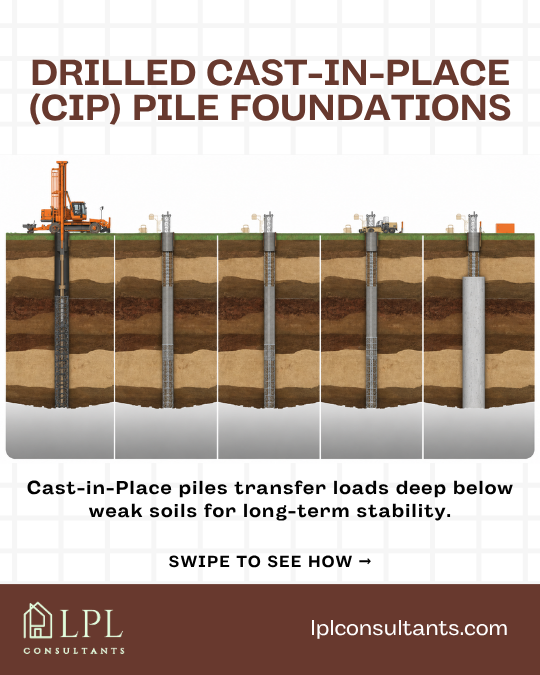
The project team evaluated multiple foundation alternatives before concluding that drilled CIP piles offered the best combination of structural performance and practical constructability for this site. Drilled CIP piles are constructed by drilling a borehole, placing a steel reinforcement cage, and filling the borehole with concrete in place — creating a robust, in-ground concrete column that transfers building loads directly to deep, competent soil or rock.
For this project, CIP piles offered several critical advantages:
- Depth capability — Extended to approximately 100 feet to reach competent bearing strata beneath the variable and problematic near-surface soils.
- Reduced vibration — Unlike driven piles, drilled CIP piles do not generate significant ground vibration during installation, reducing risk to adjacent structures on the shared hillside.
- Adaptability — Pile lengths could be adjusted in real time as actual soil conditions were encountered during drilling — a critical advantage on a site where subsurface conditions varied.
- Combined load resistance — Provided strong axial capacity for vertical loads and lateral resistance for the hillside forces acting on the structure.
- Hillside suitability — Well-suited to constrained environments where equipment access is limited and the construction footprint must be carefully managed.
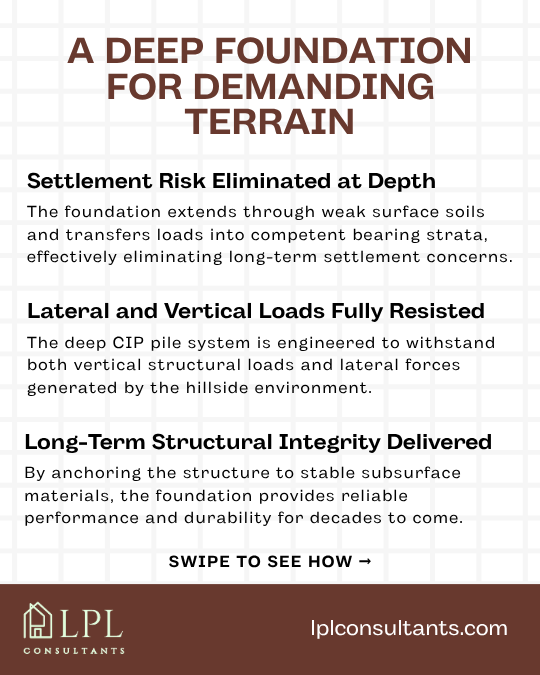
The final design allowed the structure's loads to transfer efficiently and reliably into deeper, stable bearing strata — effectively eliminating the settlement and bearing capacity risks that had ruled out every shallow alternative.
Executing a 100-Foot Deep Foundation System
Construction Coordination and Field Challenges
Engineering the right solution is one challenge. Executing it at 100-foot depths on a steep hillside is another. LPL Consultants worked closely with the geotechnical team, drilling contractor, and inspection crews throughout construction to manage a series of technically demanding field conditions:
- Maintaining borehole stability at 100-foot depths
- Active groundwater management to protect borehole integrity
- Precise reinforcement cage handling and alignment at depth
- Temporary casing to maintain borehole integrity before concrete placement
- Concrete placement sequencing to avoid voids or cold joints
- Maintaining pile verticality over 100 feet of depth
Quality Control and Inspection
For deep foundation systems, quality control is the difference between a foundation that performs for decades and one that requires intervention. LPL Consultants coordinated a comprehensive inspection and verification program throughout construction, including verification of drilled pile depths, pre-pour reinforcement inspections, concrete placement monitoring, concrete strength testing, drilling log review, and continuous coordination with special inspectors and field observation teams. Maintaining open communication between engineering, construction, and inspection teams allowed field conditions to be resolved efficiently — keeping the project moving while maintaining structural integrity.
The Outcome: A Foundation Built to Last
This project demonstrated what focused, constructability-oriented structural engineering can deliver on a site that presents few easy options. Through systematic load analysis, deliberate system selection, and hands-on construction support, LPL Consultants delivered a deep foundation system capable of supporting demanding structural loads while controlling settlement and providing reliable long-term performance — on terrain and soil conditions that had ruled out every conventional approach.
This project reflects a broader truth about challenging site development: the right outcome is rarely about finding an easier solution. It's about having the engineering depth and collaborative discipline to execute the right one.
Frequently Asked Questions
What are drilled Cast-in-Place (CIP) piles?
Drilled CIP piles are a deep foundation element constructed by drilling a borehole to the required depth, placing a steel reinforcement cage inside, and filling the borehole with concrete in place. The result is a reinforced concrete column that extends deep into the ground, transferring structural loads to competent bearing material below problematic near-surface soils.
When are deep foundations necessary?
Deep foundations are typically required when near-surface soils are too weak, inconsistent, or compressible to reliably support a structure through conventional shallow footings. Common triggers include hillside terrain with variable soils, sites with a history of settlement, sites with high groundwater, and projects with elevated structural load demands. A geotechnical investigation is the starting point for determining whether deep foundations are required.
How does hillside terrain affect foundation design?
Hillside sites introduce lateral (horizontal) forces in addition to the standard vertical gravity loads every structure must support. Foundations must be designed to resist both. Hillside sites also often have variable subsurface conditions, limited equipment access, and restricted working space, all of which influence which foundation systems are technically feasible and practically constructable.
How deep can drilled CIP piles go?
Drilled CIP piles can extend to depths exceeding 100 feet when site conditions require reaching competent bearing material at significant depth. The required depth is determined by the geotechnical investigation, which identifies where reliable bearing strata exist. On this project, piles extended approximately 100 feet to reach adequate bearing capacity.
What does a structural engineer do during deep foundation construction?
A structural engineer's involvement goes well beyond producing the initial design. Effective structural engineering support includes coordinating with the geotechnical engineer, advising on constructability decisions, providing responsive field support when conditions differ from design assumptions, overseeing quality control procedures, and maintaining coordination with inspection teams and the drilling contractor throughout construction.